
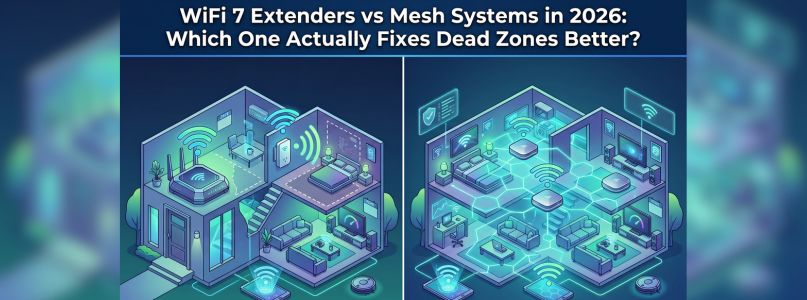
Dead zones remain one of the most frustrating home internet problems in 2026. Even with faster internet plans and advanced routers, many users still struggle with weak WiFi signals in bedrooms, basements, garages, and outdoor areas.
To solve this issue, two major solutions dominate the market today:
- WiFi 7 extenders
- Mesh WiFi systems
Both promise stronger coverage and faster speeds-but which one actually fixes dead zones better in real-world use?
In this guide, we’ll compare WiFi 7 extenders and mesh systems based on speed, coverage, stability, gaming performance, smart home compatibility, and overall value in 2026.
What Is a WiFi 7 Extender?
A WiFi extender captures your existing router signal and rebroadcasts it to weak areas of your home.
Main Goal:
- Extend coverage
- Improve signal reach
- Reduce dead zones
WiFi 7 extenders now support:
- Faster wireless speeds
- Lower latency
- Improved multi-device performance
What Is a Mesh WiFi System?
A mesh system uses multiple connected nodes working together as one seamless WiFi network.
Instead of Rebroadcasting:
Mesh systems:
- Create a unified network
- Automatically route traffic
- Improve roaming between rooms
This creates smoother whole-home coverage.
Why Dead Zones Still Happen in 2026
Modern homes are harder to cover with WiFi because of:
- Thick walls
- Multi-floor layouts
- Smart home device overload
- Metal structures
- Interference from electronics
Even high-end routers struggle to cover large homes completely.
WiFi 7 Technology Improvements
WiFi 7 introduces major upgrades over older WiFi standards.
Key Benefits:
- Faster speeds
- Reduced latency
- Better bandwidth handling
- Multi-Link Operation (MLO)
- Improved congestion management
Both extenders and mesh systems benefit from these advancements.
WiFi 7 Extenders: Advantages
- Lower Cost: Extenders are usually much cheaper than full mesh systems.
- Simple Setup: Most extenders connect quickly through apps or WPS pairing.
- Good for Small Dead Zones:
- Perfect for: One weak bedroom
- Small office
- Garage coverage
- Easy Upgrade Option: You can improve coverage without replacing your main router.
WiFi 7 Extenders: Limitations
- Reduced Speed at Distance: Extenders often lose speed while repeating signals.
- Roaming Can Be Inconsistent: Devices may switch poorly between:
- Main router
- Extender network
- Performance Depends on Placement: Poor positioning creates unstable coverage.
Mesh Systems: Advantages
- Seamless Whole-Home Coverage: Mesh systems eliminate dead zones more effectively in larger homes.
- Better Device Roaming: Phones and laptops switch smoothly between nodes.
- Stronger Multi-Device Performance:
- Ideal for homes with:
- Smart TVs
- Gaming systems
- Cameras
- Smart appliances
- Smarter Traffic Management: Mesh systems automatically optimize connections.
Mesh System Limitations
- Higher Cost: Mesh systems are significantly more expensive.
- More Complex Setup: Some systems require
- Advanced app setup
- Firmware updates
- Node optimization
- Overkill for Small Homes: A simple extender may work fine for smaller spaces.
Speed Comparison in Real-World Use
WiFi 7 Extenders:
Best For:
- Moderate internet use
- Single-room coverage
- Budget setups
Performance:
- Good speeds near extender
- Slower under heavy load
Mesh Systems:
Best For:
- Large homes
- Heavy streaming
- Gaming
- Smart home networks
Performance:
- More stable speeds
- Better long-range consistency
Gaming Performance Comparison
Gamers need:
- Low latency
- Stable connections
- Minimal packet loss
WiFi 7 Extenders:
Can introduce:
- Slight latency increase
- Signal hopping delays
Mesh Systems:
Usually provide:
- Better gaming stability
- Smarter routing
- Lower ping consistency
Mesh systems generally win for gaming households.
Smart Home Device Handling
Modern homes often contain:
- 30-50 connected devices
- Cameras
- Smart speakers
- Doorbells
- Streaming systems
Extenders:
Can become overloaded faster.
Mesh Systems:
Handle large device counts more efficiently.
Which Works Better for Different Home Sizes?
| Home Size | Best Option |
|---|---|
| Small Apartment | WiFi 7 Extender |
| Medium Home | Depends on layout |
| Large Multi-Story Home | Mesh System |
| Smart Home Setup | Mesh System |
Placement Matters for Both
Even the best equipment fails with poor placement.
Extender Placement:
- Halfway between router and dead zone
- Avoid thick walls
Mesh Node Placement:
- Evenly distributed
- Open spaces preferred
Cost Comparison in 2026
WiFi 7 Extenders:
- Lower upfront cost
- Affordable upgrade solution
Mesh Systems:
- Higher initial investment
- Better long-term performance
Common Mistakes Users Make
Extender Mistakes:
- Placing too far from router
- Using overloaded channels
Mesh Mistakes:
- Nodes placed too close together
- Ignoring firmware updates
Which Option Actually Fixes Dead Zones Better?
For Small Problems:
WiFi 7 extenders work well and save money.
For Large Homes or Heavy Usage:
Mesh systems provide:
- Better stability
- Roaming
- Better long-term coverage
Future of Home WiFi Beyond 2026
Experts expect:
- More AI-managed mesh systems
- Smarter roaming optimization
- Better WiFi 7 adoption
- Increased smart home integration
Mesh technology is becoming the preferred long-term solution for larger connected homes.
Final Thoughts
Both WiFi 7 extenders and mesh systems can improve weak WiFi coverage in 2026-but the best choice depends on your home size, device count, and internet usage.
If you only need to fix a small dead zone on a budget, a WiFi 7 extender may be enough. But if you want seamless whole-home coverage, stable gaming, better roaming, and strong smart-home performance, a mesh system usually delivers better long-term results.
The key is choosing the solution that matches your household’s actual WiFi demands-not just the fastest marketing claims.