Understanding Accuracy, Applications, and Performance in Laboratory Glassware
Laboratory glassware is essential for accurate measurement, precise chemical handling, and repeatable scientific results. However, not all glassware is manufactured to the same standards of accuracy and precision. This is where the distinction between Class A and Class B glassware becomes critical.
Whether you’re a research scientist, quality control technician, educator, or laboratory purchaser, understanding the differences can help you make informed choices — ensuring that your glassware matches the demands of your experiments and workflows.
🧪 What Is Class A Glassware?
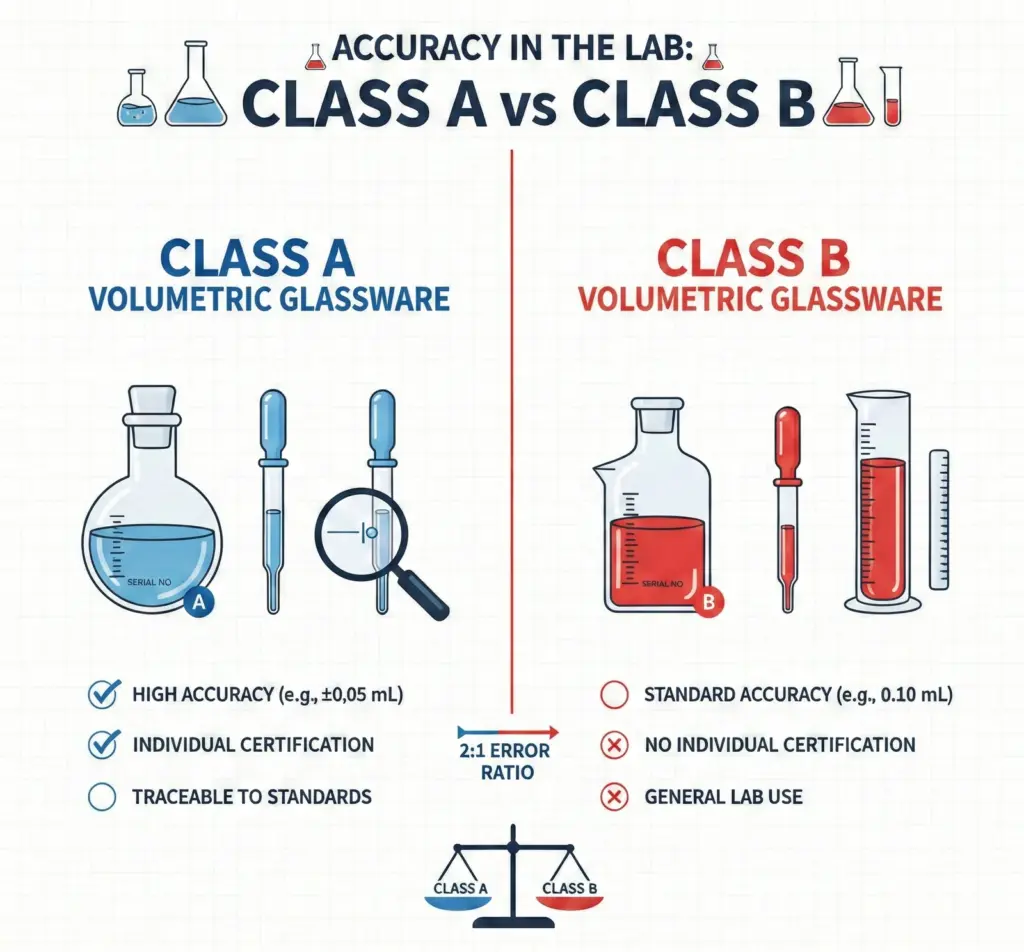
Class A glassware represents the highest level of precision and accuracy available in calibrated laboratory vessels.
🔹 Key Features of Class A:
✔ Tighter manufacturing tolerances
✔ Finer calibration accuracy
✔ Individually calibrated & traceable
✔ Often laser-etched or engraved markings
✔ Suitable for analytical work
📏 Typical Accuracy Specifications:
Class A pieces are typically manufactured to stricter error margins, which means the volume indicated on the glassware will be much closer to the actual volume than in lower-precision types.
🎯 Common Uses:
Class A glassware is ideal for tasks where precision matters most:
-
Quantitative chemical analysis
-
Standard solution preparation
-
Titration endpoints
-
Pharmaceutical formulation
-
Regulatory lab testing
These are environments where small measurement errors can lead to significant consequences.
🧫 What Is Class B Glassware?
Class B glassware is manufactured to broader tolerance limits, providing reliable measurements where absolute precision is not as critical.
🔹 Characteristics of Class B:
✔ Wider calibration error range
✔ Simple printed or etched graduations
✔ More cost-effective option
✔ Suitable for routine lab work
📊 Typical Uses:
Class B glassware is perfect for general laboratory tasks where ultra-high accuracy is not required:
-
Teaching labs and demonstrations
-
Approximate solution transfers
-
Bulk reagent volume handling
-
Routine mixing and pre-analysis steps
In many labs, Class B glassware is preferred for everyday tasks where expedited workflow and affordability are priorities.
🔍 Class A vs Class B: Side-by-Side Comparison
| Feature | Class A | Class B |
|---|---|---|
| Calibration Tolerance | Very narrow (high precision) | Wider (standard precision) |
| Marking Method | Precision etched or laser-engraved | Screen-printed or simple etching |
| Typical Accuracy | ±0.5% or better | ±1–2% or wider |
| Best For | Analytical & quantitative work | Teaching |
| Cost | Higher | Lower |
| Traceability | Often certified | Not always certified |
| Preferred In | Pharmaceuticals, QA/QC labs | Teaching labs, industrial prep |
🧠 Why Accuracy Matters in Laboratory Glassware
Precision and accuracy are not just lab buzzwords — they determine the reliability of your data and the reproducibility of experiments.
✔ When to Choose Class A:
-
Your test results must meet regulatory standards
-
You’re performing titrations with narrow equivalence points
-
You prepare primary standards for calibration
-
You’re performing volumetric analysis
✔ When Class B Is Appropriate:
-
You’re training students in basic techniques
-
You’re measuring approximate volumes for wash steps
-
You need cost-effective glassware for high-volume tasks
Matching the class of glassware to your application ensures reliable results while optimizing your lab budget.
🛠️ Accuracy in Practice — Real Examples
🟦 Example 1: Preparing a Standard Solution
In a pharmaceutical lab, solution concentration must be exact. Using Class A volumetric flasks ensures that the solution volume is within acceptable error limits for regulatory compliance.
🟩 Example 2: Routine Solution Transfer
In a teaching lab, students may transfer 50 mL of reagent into a beaker for demonstration. Class B glassware is sufficient and cost-effective here since minor inaccuracies don’t affect the learning outcome.
📦 Traceability & Certification
Class A glassware often comes with calibration certificates and traceability documentation — which lab accreditation bodies or regulatory auditors may require.
Class B glassware may not always include certified traceability, but it meets standardized production quality suitable for everyday use.
🧪 How Calibration Works
Calibration is the process of verifying that the volume markings on glassware correspond to real volumes within a defined error range.
In Class A:
-
Calibration is performed under controlled conditions
-
Results are documented
-
Tolerance limits are tight
In Class B:
-
Calibration is standard
-
Markings are useful for approximate measurement
-
Tolerance limits are broader
Calibrated glassware ensures that your measured volumes reflect what you intend — a key requirement for reliable data.
🧰 How to Choose Between Class A & Class B
Ask questions like:
🔹 How critical is measurement accuracy for this task?
🔹 Does the work require regulatory compliance?
🔹 Are you preparing standards or analytical samples?
🔹 Is cost a factor for high-volume operations?
Answering these helps determine whether Class A or Class B glassware is the right choice.
💡 Tips for Using Glassware Accurately
To get the best results from any class of glassware:
✔ Use clean, dry glassware
✔ Read meniscus at eye level
✔ Avoid parallax error
✔ Use appropriate thermal conditions
✔ Replace worn or scratched pieces
Accuracy is a combination of good glassware and good laboratory technique.
🧠 Final Takeaway
Choosing the right class of glassware isn’t just about precision — it’s about matching your measurement confidence to your work requirements:
-
Class A = precision, traceability, and analytical confidence
-
Class B = practicality, affordability, and general laboratory use
Both classes have their place — and understanding the difference empowers better decision-making in the lab and procurement planning.